ASK SENSEI
.net
AN E-LEARNING TOOL BUILT JUST FOR YOU
Whiteboard
SAT® Vocab Practice
Tutorial
About
Contact
Math Studio
Whiteboard
SAT® Vocab Practice
Tutorial
About
Contact
Math Studio
Log in
Algebra I - Sets
• Mathematics •
Algebra I
Sets
A **set** is any finite or infinite collection of things called members or elements. Sets are denoted by enclosing their elements in braces `{}`. For example, $N = \{1, 2, 3, \dots\}$ represents the infinite set of natural numbers. The notation $a \in N$ means that $a$ is in $N$, or $a$ is an element of $N$. **Set Definitions & Operations** * **Empty set (or null set):** Denoted as $\emptyset$ or $\{\}$, this is the set without any elements. Note that $\{0\}$ is a set containing one element ($0$), so it is not the same as the empty set. * **Union of two sets ($A \cup B$):** The set of all elements that are in either set (or in both). For example, if $A = \{1, 2, 3\}$ and $B = \{2, 4, 6\}$, then $A \cup B = \{1, 2, 3, 4, 6\}$. * **Intersection of two sets ($A \cap B$):** The set of all elements that are in both $A$ and $B$. Using the same example where $A = \{1, 2, 3\}$ and $B = \{2, 4, 6\}$, then $A \cap B = \{2\}$. Two sets with no elements in common are called **disjoint**, and their intersection is the empty set. * **Complement of a set ($\bar{A}$):** The set of all elements that are not in $A$. For example, if the universal set being discussed is $\{1, 2, 3, 4, 5, 6\}$ and $A = \{1, 2, 3\}$, then $\bar{A} = \{4, 5, 6\}$. It is always true that $A \cap \bar{A} = \emptyset$ and $A \cup \bar{A}$ is everything. * **Subset ($A \subset C$):** $A$ is a subset of $C$ if all the elements of $A$ are also elements of $C$. For example, if $A = \{1, 2, 3\}$ and $C = \{-2, 0, 1, 2, 3, 4, 5, 8\}$, then $A \subset C$. **Venn Diagrams** * **Visual Representation:** A Venn Diagram visually represents the relationship between two or more sets using circle-like shapes, with the elements of each set pictured inside its corresponding shape. * **Overlapping Sections:** Elements located in an overlapping section of two sets belong to both sets, representing their intersection. 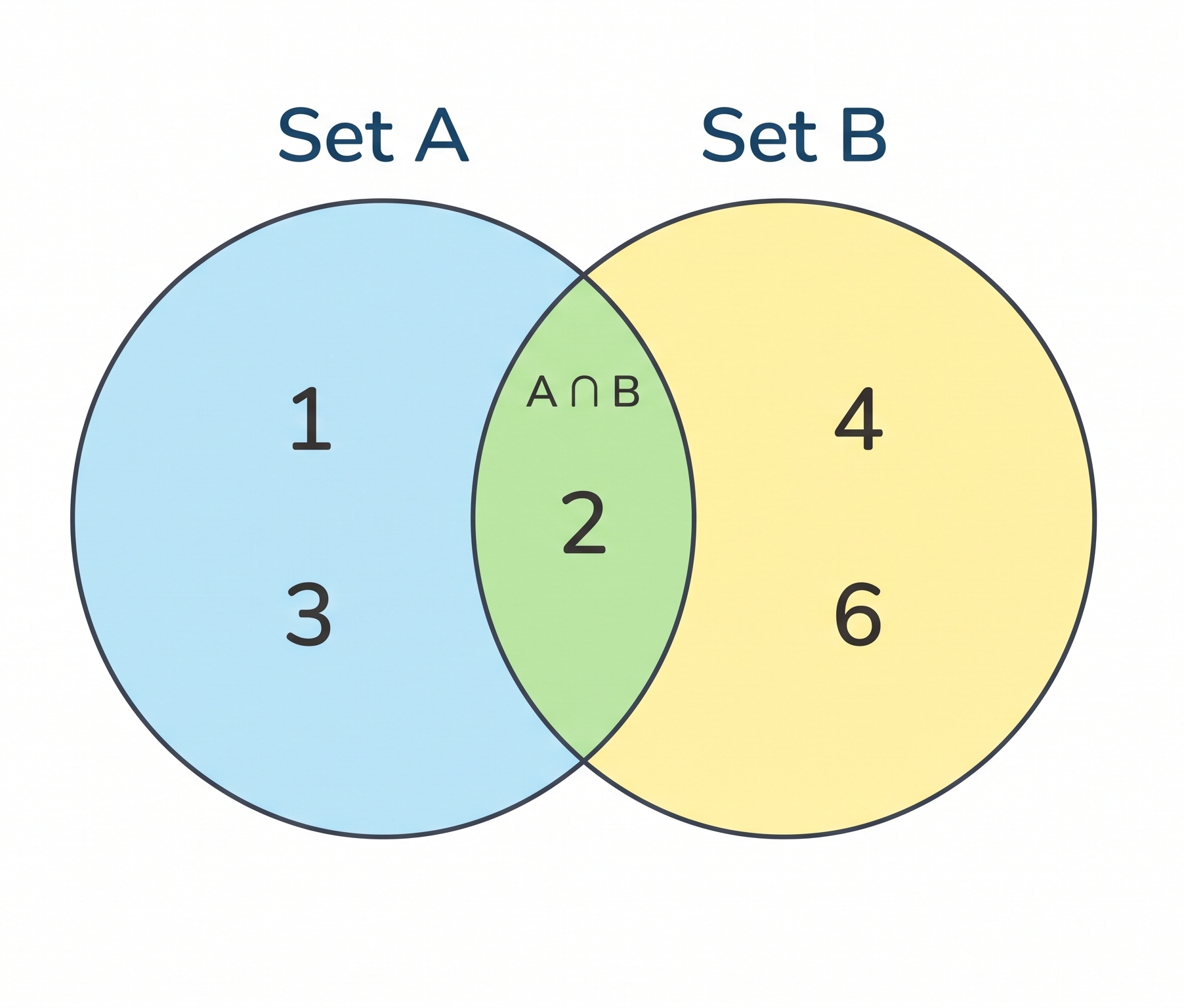 * **Counting Elements:** To find the number of elements in the union of two sets, use the formula: $(\text{size of } A \cup B) = (\text{size of } A) + (\text{size of } B) - (\text{size of } A \cap B)$.