ASK SENSEI
.net
AN E-LEARNING TOOL BUILT JUST FOR YOU
Whiteboard
SAT® Vocab Practice
Tutorial
About
Contact
Math Studio
Whiteboard
SAT® Vocab Practice
Tutorial
About
Contact
Math Studio
Log in
What is Central Limit Theorem (CLT)
• Mathematics •
Central Limit Theorem
Statistics
Probability
The Central Limit Theorem (CLT) is a fundamental concept in statistics that describes the behavior of the distribution of sample means. In essence, it states that the distribution of the sample mean will be approximately normally distributed, even if the underlying population distribution is not normal. 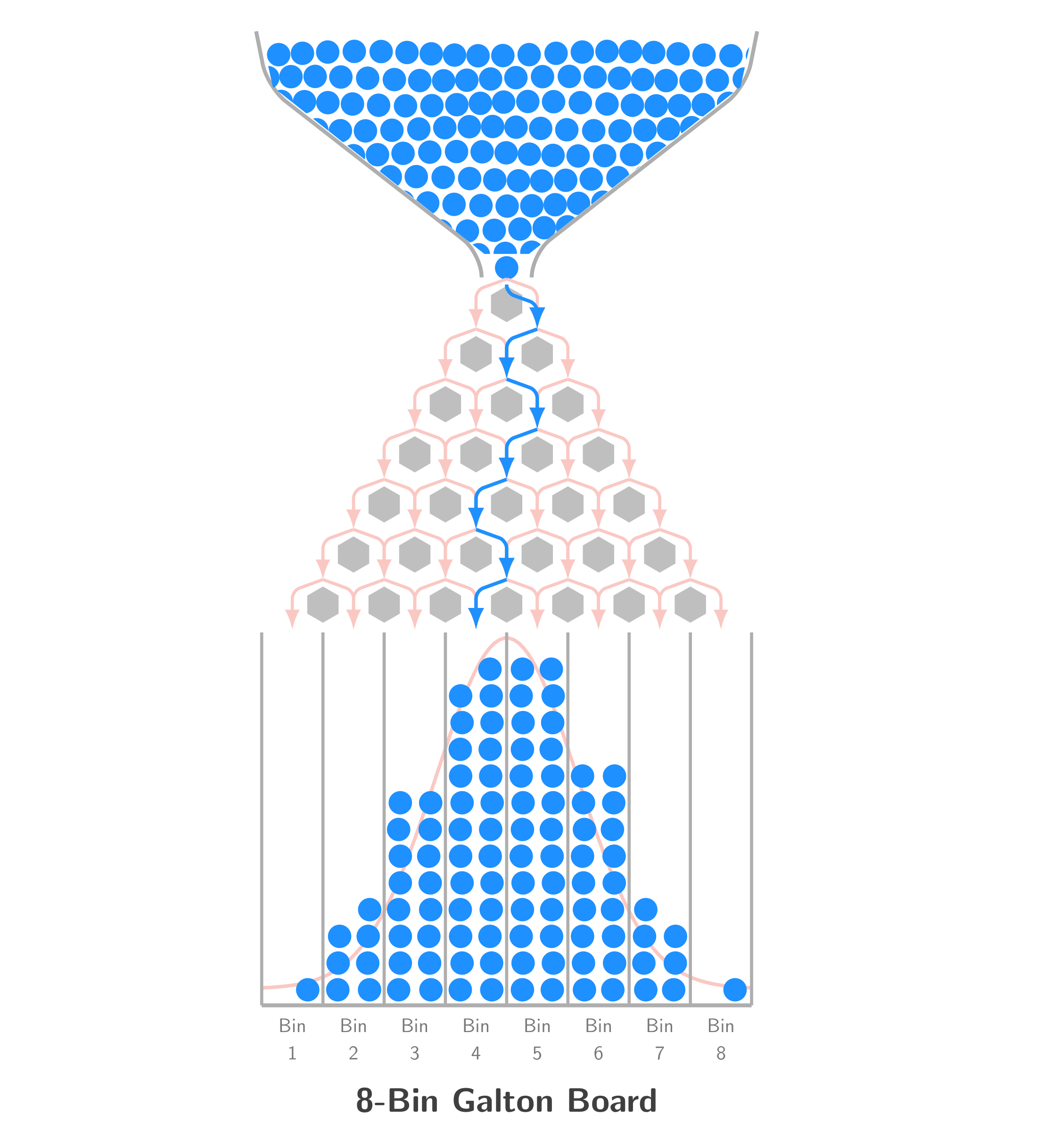 To break it down, let's consider the following: * Let $X_1, X_2, ..., X_n$ be a random sample of size $n$ from a population with mean $\mu$ and variance $\sigma^2$. * The sample mean $\overline{X}$ is calculated as $\overline{X} = \frac{1}{n} \sum_{i=1}^{n} X_i$. * The Central Limit Theorem states that, as the sample size $n$ increases, the distribution of $\overline{X}$ will converge to a normal distribution with mean $\mu$ and variance $\frac{\sigma^2}{n}$. Mathematically, this can be expressed as: $$\sqrt{n} \left( \frac{\overline{X} - \mu}{\sigma} \right) \xrightarrow{d} \mathcal{N}(0, 1)$$ where $\xrightarrow{d}$ denotes convergence in distribution, and $\mathcal{N}(0, 1)$ is the standard normal distribution. The CLT has several important implications: 1. **Approximation of the sample mean distribution**: For large sample sizes, the distribution of the sample mean can be approximated by a normal distribution, even if the underlying population distribution is not normal. 2. **Standard error of the mean**: The standard error of the mean (SEM) is given by $\frac{\sigma}{\sqrt{n}}$, which provides a measure of the variability of the sample mean. 3. **Confidence intervals**: The CLT can be used to construct confidence intervals for the population mean, which are essential in statistical inference. Practical use cases of the Central Limit Theorem include: * **Survey research**: When conducting surveys, the CLT can be used to estimate the population mean and construct confidence intervals for the mean. * **Quality control**: In manufacturing, the CLT can be used to monitor the mean quality of a product and detect any deviations from the expected mean. * **Finance**: The CLT is used in finance to model stock prices and returns, which are often assumed to follow a normal distribution. * **Medical research**: The CLT is used in medical research to estimate the mean response to a treatment and construct confidence intervals for the mean response. Some examples of how the CLT can be applied in real-world scenarios include: * A company wants to estimate the average height of its employees. By taking a random sample of employees, the CLT can be used to estimate the population mean height and construct a confidence interval for the mean. * A researcher wants to study the effect of a new medication on blood pressure. By taking a random sample of patients, the CLT can be used to estimate the mean response to the medication and construct a confidence interval for the mean response. * A financial analyst wants to model the stock price of a company. By assuming that the stock price follows a normal distribution, the CLT can be used to estimate the mean and variance of the stock price. In conclusion, the Central Limit Theorem is a powerful tool in statistics that provides a framework for understanding the behavior of the sample mean and constructing confidence intervals for the population mean. Its applications are diverse and far-reaching, and it is an essential concept for anyone working in statistics, data science, or related fields.