ASK SENSEI
.net
AN E-LEARNING TOOL BUILT JUST FOR YOU
Whiteboard
SAT® Vocab Practice
Tutorial
About
Contact
Math Studio
Whiteboard
SAT® Vocab Practice
Tutorial
About
Contact
Math Studio
Log in
Algebra I - Number Systems
• Mathematics •
Algebra I
Number Systems
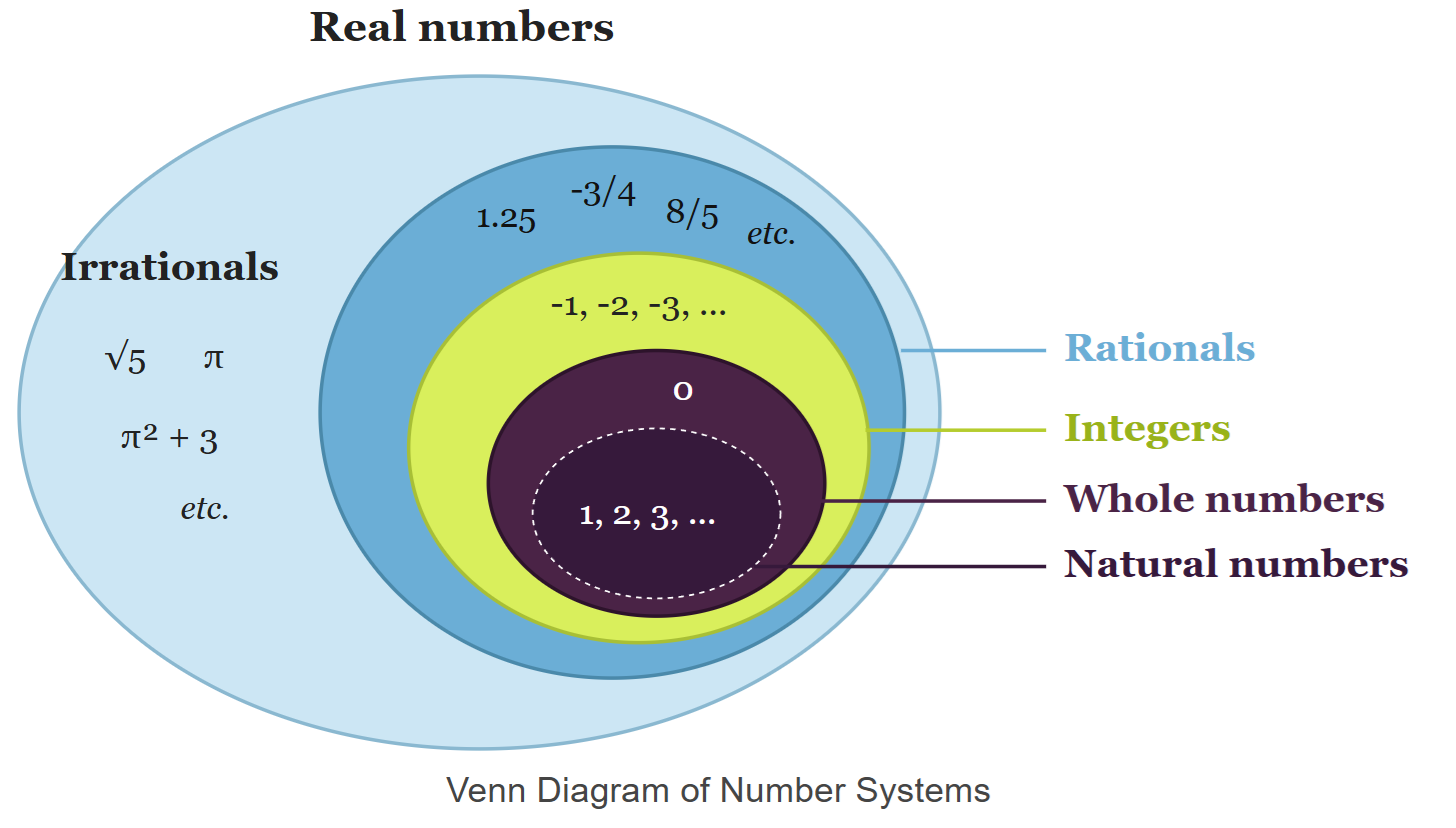
The number system is organized into several hierarchical sets of numbers: * **Natural Numbers:** The numbers used for counting ($1, 2, 3, 4, 5, 6, \dots$). * **Whole Numbers:** All the counting (natural) numbers plus zero ($0, 1, 2, 3, 4, 5, 6, \dots$). * **Integers:** The counting numbers, their negatives, and zero ($\dots, -2, -1, 0, 1, 2, 3, \dots$). * *Positive integers* are the natural numbers. * *Negative integers* are the "minus" natural numbers ($-1, -2, -3, -4, \dots$). * **Rational Numbers:** All numbers that can be expressed as fractions. These fractions can be proper (less than one) or improper (more than one), and they can be positive (e.g., $5.125 = \frac{41}{8}$) or negative (e.g., $-\frac{3}{4}$). Every integer is also a rational number (for example, $4 = \frac{4}{1}$). * **Real Numbers:** Numbers that can be represented as points on the number line. All rational numbers are real, as are the points on the number line "between" rational numbers, which are called **irrational numbers** (such as $\sqrt{5}$, $\pi$, $\pi^2 + 3$, $\sqrt{3} - 9$, and $0.12112111211112\dots$). * **Imaginary Numbers:** The square roots of negative numbers. They do not appear on the real number line and are written in terms of $i = \sqrt{-1}$ (for example, $\sqrt{-49}$ is imaginary and equals $i\sqrt{49}$ or $7i$). * **Complex Numbers:** All possible sums of real and imaginary numbers, written in the form $a + bi$, where $a$ and $b$ are real numbers and $i = \sqrt{-1}$ is imaginary. All real numbers are complex (where $b = 0$), and all imaginary numbers are complex (where $a = 0$).