ASK SENSEI
.net
AN E-LEARNING TOOL BUILT JUST FOR YOU
Whiteboard
SAT® Vocab Practice
Tutorial
About
Contact
Math Studio
Whiteboard
SAT® Vocab Practice
Tutorial
About
Contact
Math Studio
Log in
Algebra I - Cartesian plane
• Mathematics •
Algebra I
Cartesian plane
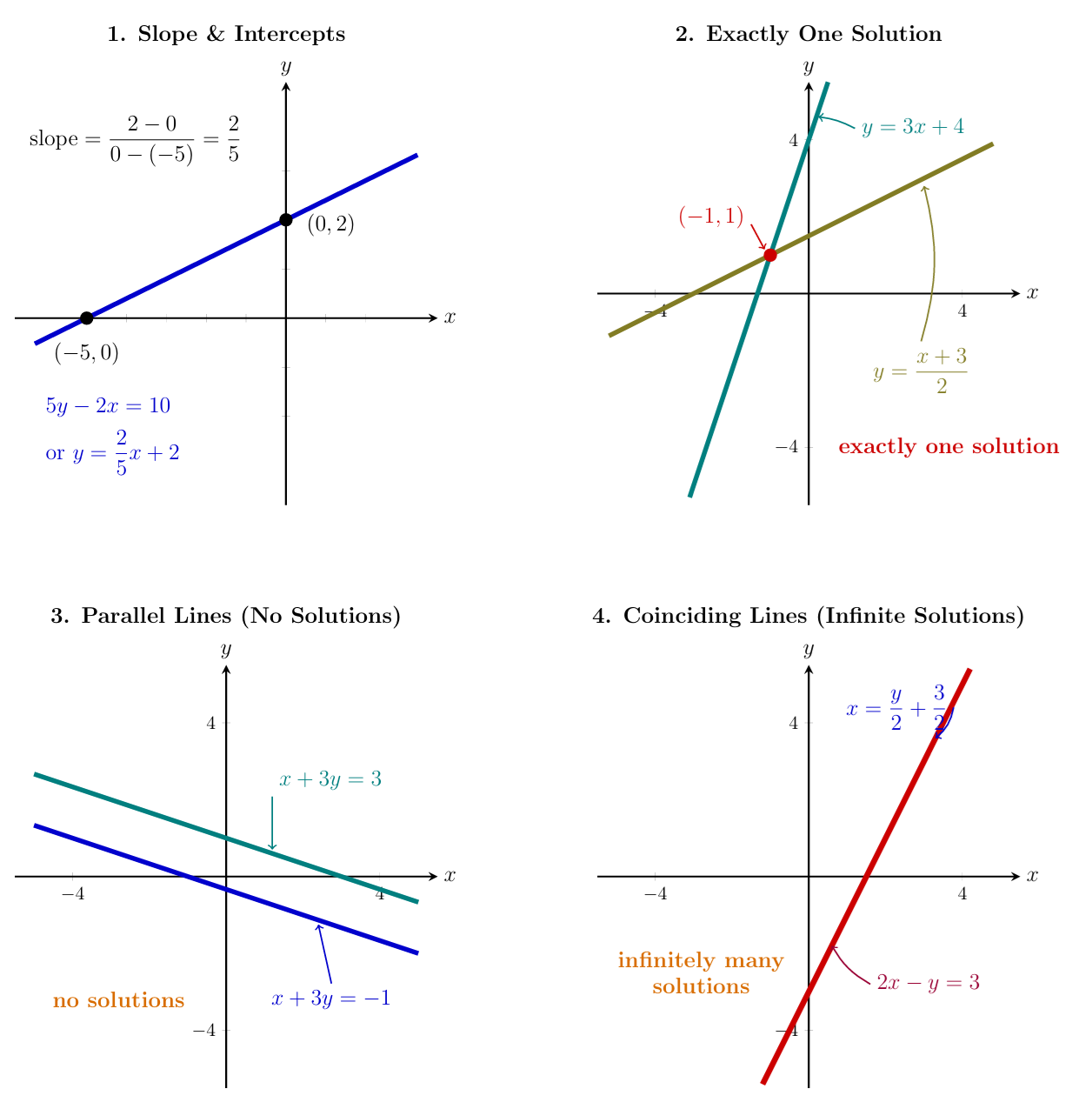
The **Cartesian (or coordinate) plane** is a method for naming each point in a plane based on its distance from two special perpendicular lines called **axes**. --- ### Terminology of the Cartesian Plane * **$x$-axis:** Usually the horizontal axis of the coordinate plane. Positive distances are measured to the right, and negative distances are measured to the left. * **$y$-axis:** Usually the vertical axis of the coordinate plane. Positive distances are measured up, and negative distances are measured down. * **Origin:** The point $(0, 0)$, which is the point of intersection of the $x$-axis and the $y$-axis. * **Quadrants:** The four regions of the plane cut by the two axes. By convention, they are numbered counterclockwise starting with the upper right: * **Quadrant I (upper right):** $x$ is $+$, $y$ is $+$. * **Quadrant II (upper left):** $x$ is $-$, $y$ is $+$. * **Quadrant III (lower left):** $x$ is $-$, $y$ is $-$. * **Quadrant IV (lower right):** $x$ is $+$, $y$ is $-$. * **Point:** A location on a plane identified by an ordered pair of coordinates enclosed in parentheses, $(a, b)$. The first coordinate is measured along the $x$-axis, and the second is measured along the $y$-axis. For example, the point $(1, 2)$ is $1$ unit to the right and $2$ units up from the origin. Occasionally (though rarely), the first coordinate is called the *abscissa* and the second is called the *ordinate*. --- ### Lines in the Cartesian Plane A straight line is uniquely identified by any two points, or by any one point and the incline (or **slope**) of the line. * **Slope of a line ($m$):** Measures how steep a line is—specifically, how fast the line moves "up" for every bit that it moves "over" (left or right). If $(a, b)$ and $(c, d)$ are two points on the line, then the slope is: $$\text{slope} = \frac{\text{change in } y}{\text{change in } x} = \frac{d - b}{c - a}$$ * Any pair of points on a straight line will give the same slope value. * **Horizontal lines** have a slope of $0$ ($m = 0$). * **Vertical lines** have an undefined slope ("infinitely large"). * Lines that go "up right" and "down left" (ending in Quadrants I and III) have a **positive slope** ($0 < m < 1$ is flatter; $m > 1$ is steeper). * Lines that go "up left" and "down right" (ending in Quadrants II and IV) have a **negative slope** ($-1 < m < 0$ is flatter; $m < -1$ is steeper). * **Parallel lines** have the exact same slope. * **Perpendicular lines** have slopes that are negative reciprocals of each other: if two lines with slopes $m_1$ and $m_2$ are perpendicular, then $m_1 m_2 = -1$ and $m_2 = -\frac{1}{m_1}$. * **$x$-intercept:** The $x$-coordinate of the point where a line crosses the $x$-axis. The $x$-intercept of a line that crosses the $x$-axis at $(a, 0)$ is $a$. Horizontal lines have no $x$-intercept. * **$y$-intercept:** The $y$-coordinate of the point where a line crosses the $y$-axis. The $y$-intercept of a line that crosses the $y$-axis at $(0, b)$ is $b$. Vertical lines have no $y$-intercept. --- ### Graphing Linear Equations A linear equation in two variables (say $x$ and $y$) can be manipulated—after grouping all $x$-terms, $y$-terms, and constant terms together—into the form $Ax + By = C$. The graph of this equation is a straight line. * **Using the slope to graph:** Plot one point of the line. If the slope is expressed as a ratio of small whole numbers, keep plotting points "up and over" from the previous point until you have enough to draw the line. * **Finding intercepts:** To find the $y$-intercept, set $x = 0$ and solve for $y$. To find the $x$-intercept, set $y = 0$ and solve for $x$. * **Slope-Intercept Form ($y = mx + b$):** One of the easiest-to-graph forms of a linear equation, where $m$ is the slope and $b$ is the $y$-intercept, making $(0, b)$ a point on the line. * **Point-Slope Form ($y - k = m(x - h)$):** Here, $m$ is the slope and $(h, k)$ is a point on the line. * **Standard Form ($Ax + By = C$):** * *Less thinking:* Solve for $y$ and put the equation into slope-intercept form. * *Less work:* Find the $x$- and $y$-intercepts, plot them, and connect the line. (In this form, the slope is $-\frac{A}{B}$, the $y$-intercept is $\frac{C}{B}$, and the $x$-intercept is $\frac{C}{A}$). * **Any Other Form:** If you are sure an equation is linear but it isn't in a nice form, find a couple of solutions, plot those points, and connect them with a straight line. --- ### Finding the Equation of a Line Any line in the Cartesian plane represents a linear relationship between $x$ and $y$ values that can be expressed as $Ax + By = C$ for some real numbers $A, B, C$. The coordinates of every point on the line will satisfy the equation. * **Horizontal line** at height $b$: $y = b$. * **Vertical line** with $x$-intercept $a$: $x = a$. * **Given slope $m$ and $y$-intercept $b$:** * *Equation:* $y = mx + b$. * *Standard form:* $mx - y = -b$. * **Given slope $m$ and any point $(x_0, y_0)$:** * *Equation:* $y - y_0 = m(x - x_0)$. * *Standard form:* $mx - y = mx_0 - y_0$. * *Alternative:* Write down $y_0 = mx_0 + b$ and solve for $b = y_0 - mx_0$ to get the slope-intercept form. * **Given two points $(x_1, y_1)$ and $(x_2, y_2)$:** * Find the slope $m = \frac{y_2 - y_1}{x_2 - x_1}$. * *Equation:* $y - y_1 = m(x - x_1) = \frac{y_2 - y_1}{x_2 - x_1}(x - x_1)$, or $y - y_2 = m(x - x_2)$. * **Given slope $m$ and $x$-intercept $a$:** * *Equation:* $x = \frac{y}{m} + a$. * **Given $x$-intercept $a$ and $y$-intercept $b$:** * *Equation:* $\frac{x}{a} + \frac{y}{b} = 1$. * **Given a point on the line and the equation of a parallel line:** * Find the slope of the parallel line; the slope of the original line is the same. Then use point-slope form. * **Given a point on the line and the equation of a perpendicular line:** * Find the slope $m_0$ of the perpendicular line; the slope of the original line is $-\frac{1}{m_0}$. Then use point-slope form.