ASK SENSEI
.net
AN E-LEARNING TOOL BUILT JUST FOR YOU
Whiteboard
SAT® Vocab Practice
Tutorial
About
Contact
Math Studio
Whiteboard
SAT® Vocab Practice
Tutorial
About
Contact
Math Studio
Log in
Calculus I reference guide
• Mathematics •
Calculus
### 1. Foundations and Core Function Types Calculus is divided into **differential calculus** (studying rates of change at specific points) and **integral calculus** (studying accumulated areas under curves), connected by the Fundamental Theorem of Calculus. Functions map an input domain to an output range. Key function classes include: * **Linear Functions:** $y = mx + b$, where $m$ is the slope and $b$ is the $y$-intercept. * **Polynomial Functions:** General form: $$f(x) = a_n x^n + a_{n-1} x^{n-1} + \dots + a_1 x + a_0$$ * **Exponential & Logarithmic Functions:** Inverse relationships characterized by rapid growth ($y = a^x$) and logarithmic scaling ($y = \log_a x$). * **Trigonometric Functions:** Periodic sinusoidal waves defined on the unit circle where $x = \cos \theta$ and $y = \sin \theta$. --- ### 2. Function Transformations and Trigonometric Identities Functions can be manipulated algebraically and graphically via shifts, stretches, and reflections: * **Vertical/Horizontal Shifts:** $y = f(x) + c$ shifts vertically, while $y = f(x - c)$ shifts horizontally. * **Stretching/Compressing:** $y = cf(x)$ scales vertically by factor $c$. * Core Trigonometric Identities: $$\sin^2 A + \cos^2 A = 1 \quad \text{and} \quad \tan^2 A + 1 = \sec^2 A$$ $$\sin(2A) = 2 \sin A \cos A$$ $$\cos(2A) = \cos^2 A - \sin^2 A = 2\cos^2 A - 1 = 1 - 2\sin^2 A$$ --- ### 3. Limits, Continuity, and Asymptotes A limit describes the value a function approaches as the input nears a specific point: * **Formal Limit Definition:** $\lim_{x \to a} f(x) = L$ if for every $\epsilon > 0$ there exists a $\delta > 0$ such that $\vert{}x - a\vert{} < \delta$ implies $\vert{}f(x) - L\vert{} < \epsilon$. * **Continuity:** A function is continuous at $x = a$ if $f(a)$ exists and equals $\lim_{x \to a} f(x)$. * **Asymptotes:** Vertical asymptotes occur where limits diverge to $\pm\infty$ (e.g., $f(x) = \frac{1}{x}$ at $x = 0$), whereas horizontal asymptotes describe behavior as $x \to \pm\infty$. --- ### 4. Derivative Foundations and Differentiation Rules The derivative represents the instantaneous rate of change or the slope of the tangent line: * **Limit Definition:** $$f'(x) = \lim_{h \to 0} \frac{f(x+h) - f(x)}{h}$$ * **Product Rule:** $\frac{d}{dx}[f(x)g(x)] = f'(x)g(x) + f(x)g'(x)$ * **Quotient Rule:** $\frac{d}{dx}\left[\frac{f(x)}{g(x)}\right] = \frac{f'(x)g(x) - f(x)g'(x)}{[g(x)]^{2}}$ * **Chain Rule:** $\frac{dy}{dx} = \frac{dy}{du} \cdot \frac{du}{dx}$ --- ### 5. Derivative Reference Table The table below summarizes the derivatives of foundational functions: | Function Category | Function $f(x)$ | Derivative $f'(x)$ | | --- | --- | --- | | **Constant** | $c$ | $0$<br> | | **Power Rule** | $x^n$ | $nx^{n-1}$<br> | | **Exponential** | $e^x$ | $e^x$<br> | | **Natural Log** | $\ln x$ | $\frac{1}{x}$<br> | | **Sine** | $\sin x$ | $\cos x$ | | **Cosine** | $\cos x$ | $-\sin x$ | | **Tangent** | $\tan x$ | $\sec^2 x$ | --- ### 6. Applications of Derivatives and Graph Analysis Derivatives enable curve sketching, optimization, and kinematic analysis (position $s(t)$, velocity $v(t) = s'(t)$, and acceleration $a(t) = v'(t)$). 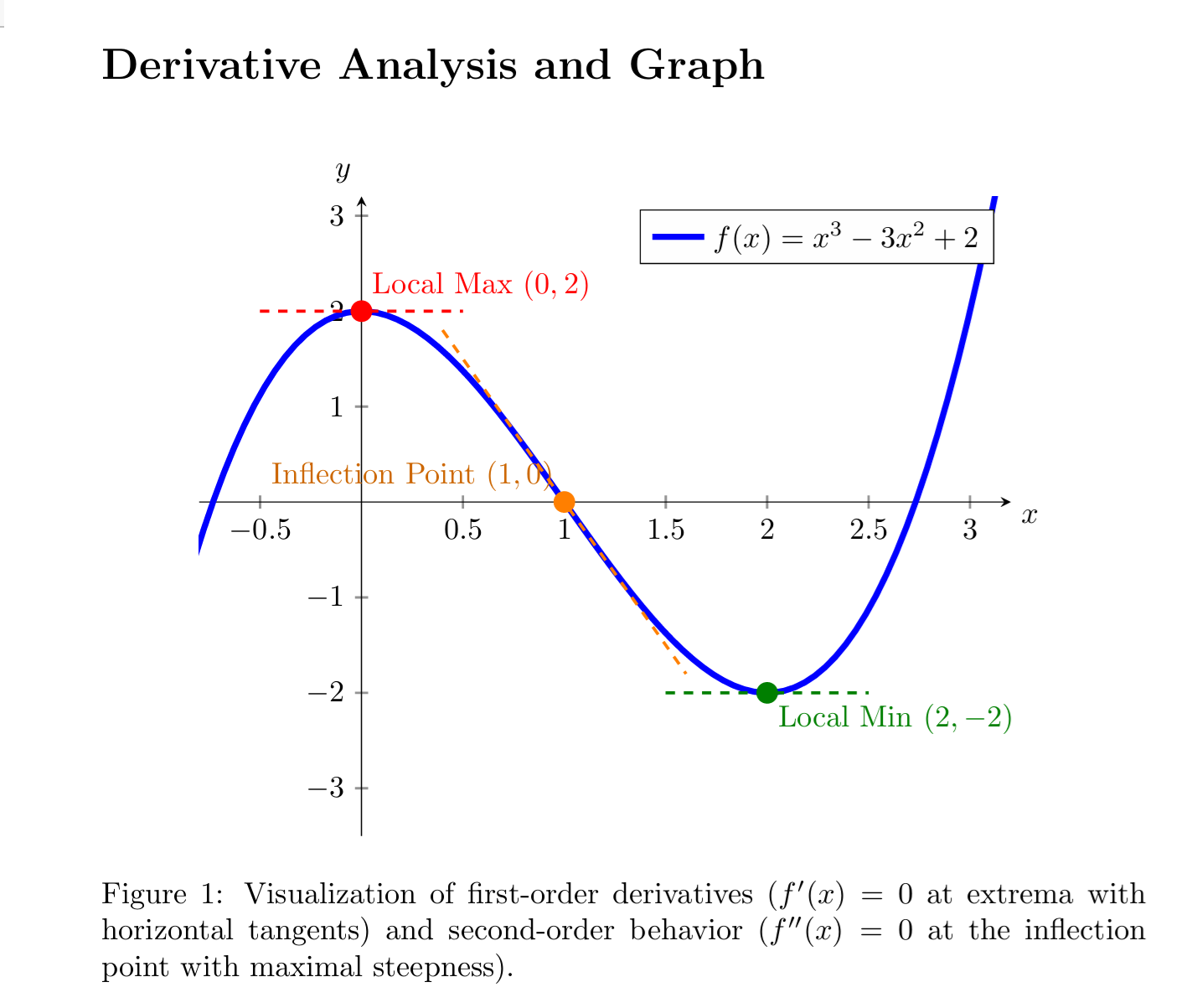 **Graph Analysis Relationship:** When analyzing a curve $y = f(x)$ alongside its derivatives $y = f'(x)$ and $y = f''(x)$: * **Local Extrema:** Occur where $f'(x) = 0$ or is undefined (peaks and valleys). * **Concavity:** Determined by $f''(x)$ (concave up when $f''(x) > 0$, concave down when $f''(x) < 0$). * **Points of Inflection:** Occur where concavity changes and $f''(x) = 0$ * **Mean Value Theorem (MVT):** If continuous on $[a,b]$ and differentiable on $(a,b)$, there exists a point $c$ where: $$f'(c) = \frac{f(b) - f(a)}{b - a}$$ * **L'Hôpital's Rule:** Used for indeterminate forms ($\frac{0}{0}$ or $\frac{\pm\infty}{\pm\infty}$) by taking derivatives of the numerator and denominator: $\lim_{x \to a} \frac{f(x)}{g(x)} = \lim_{x \to a} \frac{f'(x)}{g'(x)}$.