ASK SENSEI
.net
AN E-LEARNING TOOL BUILT JUST FOR YOU
Whiteboard
SAT® Vocab Practice
Tutorial
About
Contact
Math Studio
Whiteboard
SAT® Vocab Practice
Tutorial
About
Contact
Math Studio
Log in
Ideal Gas Law
• Chemistry •
Ideal gas law
Chemistry
The ideal gas law is a fundamental principle in physics and chemistry that describes the behavior of ideal gases. An ideal gas is a hypothetical gas that obeys the following assumptions: 1. The gas molecules are point particles, meaning they have no volume. 2. The gas molecules do not interact with each other, except for elastic collisions. 3. The gas molecules are in constant random motion. 4. The gas is in thermal equilibrium, meaning the temperature is uniform throughout. The ideal gas law is a mathematical equation that relates the pressure ($P$), volume ($V$), and temperature ($T$) of an ideal gas. The equation is: $$PV = nRT$$ where: * $P$ is the pressure of the gas * $V$ is the volume of the gas * $n$ is the number of moles of gas * $R$ is the gas constant * $T$ is the temperature of the gas in Kelvin 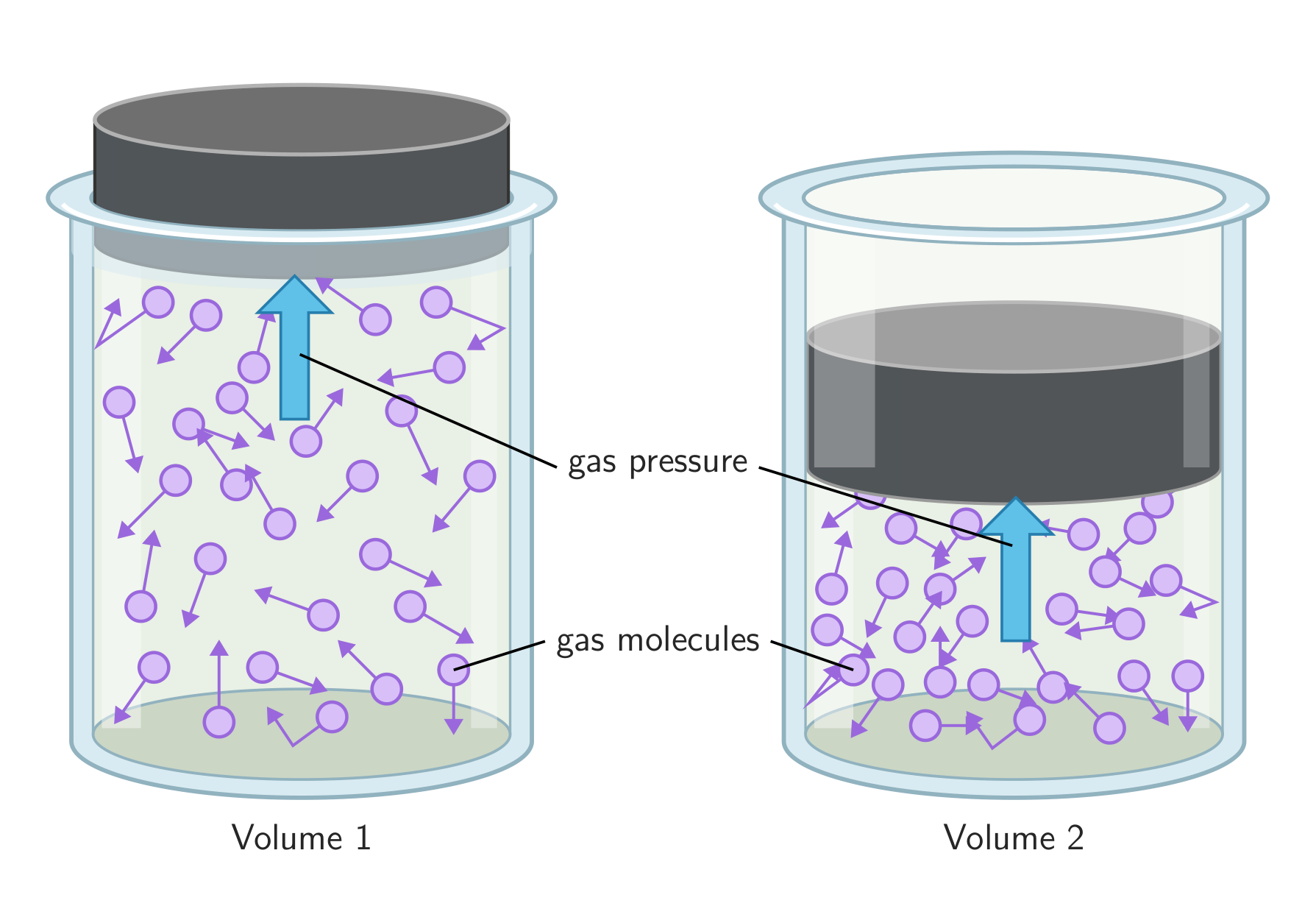 **Origin** The ideal gas law was first proposed by Émile Clapeyron in 1834, based on the work of earlier scientists such as Robert Boyle and Jacques Charles. The law was later refined and developed by other scientists, including Ludwig Boltzmann and Willard Gibbs. The ideal gas law is a combination of three earlier laws: 1. **Boyle's Law** (1662): $PV = \text{constant}$ at constant temperature 2. **Charles' Law** (1787): $\frac{V}{T} = \text{constant}$ at constant pressure 3. **Avogadro's Law** (1811): $\frac{V}{n} = \text{constant}$ at constant temperature and pressure These laws were combined and generalized to form the ideal gas law, which is a fundamental principle in physics and chemistry. **Different Forms** The ideal gas law can be expressed in different forms, depending on the specific application and the variables of interest. Some common forms of the ideal gas law include: 1. $PV = nRT$: This is the most common form of the ideal gas law, which relates the pressure, volume, and temperature of an ideal gas. 2. $P = \frac{nRT}{V}$: This form of the ideal gas law is useful for calculating the pressure of an ideal gas, given the number of moles, temperature, and volume. 3. $V = \frac{nRT}{P}$: This form of the ideal gas law is useful for calculating the volume of an ideal gas, given the number of moles, temperature, and pressure. 4. $n = \frac{PV}{RT}$: This form of the ideal gas law is useful for calculating the number of moles of an ideal gas, given the pressure, volume, and temperature. The ideal gas law can also be expressed in terms of other variables, such as the density ($\rho$) and the molar mass ($M$) of the gas. For example: 1. $P = \frac{\rho RT}{M}$: This form of the ideal gas law relates the pressure of an ideal gas to its density and molar mass. 2. $V = \frac{M}{\rho}$: This form of the ideal gas law relates the volume of an ideal gas to its molar mass and density. **Applications** The ideal gas law has numerous applications in physics, chemistry, and engineering, including: 1. **Thermodynamics**: The ideal gas law is a fundamental principle in thermodynamics, which is the study of the relationships between heat, work, and energy. 2. **Chemical reactions**: The ideal gas law is used to predict the behavior of gases in chemical reactions, such as the formation of gases in a reaction vessel. 3. **Aerospace engineering**: The ideal gas law is used to model the behavior of gases in aerospace applications, such as the atmosphere and the behavior of gases in rocket engines. 4. **Refrigeration**: The ideal gas law is used to design and optimize refrigeration systems, such as air conditioners and refrigerators. In summary, the ideal gas law is a fundamental principle in physics and chemistry that describes the behavior of ideal gases. The law can be expressed in different forms, depending on the specific application and the variables of interest. The ideal gas law has numerous applications in thermodynamics, chemical reactions, aerospace engineering, and refrigeration, among other fields. $$\frac{dP}{dT} = \frac{nR}{V}$$ This equation shows the relationship between the pressure and temperature of an ideal gas, and is a fundamental principle in thermodynamics. $$\frac{dV}{dT} = \frac{nR}{P}$$ This equation shows the relationship between the volume and temperature of an ideal gas, and is a fundamental principle in thermodynamics. $$\frac{dP}{dV} = -\frac{nRT}{V^2}$$ This equation shows the relationship between the pressure and volume of an ideal gas, and is a fundamental principle in thermodynamics. These equations are all based on the ideal gas law, and are used to describe the behavior of ideal gases in a wide range of applications.